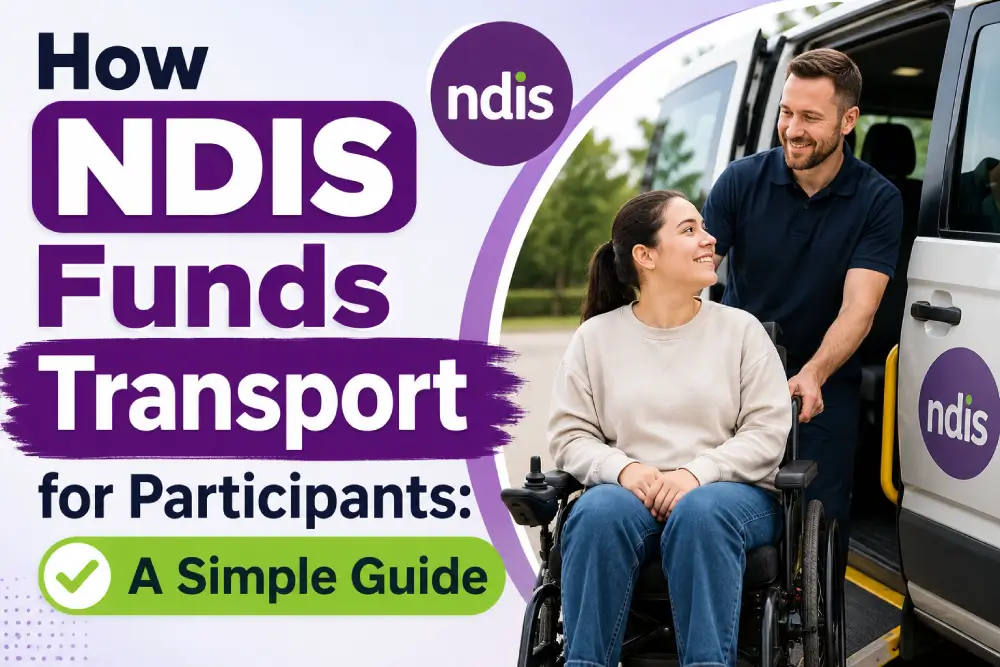
Transport is one of the most confusing parts of an NDIS plan. Participants end up with funding they don’t know how to spend, or they run out before the plan year is over because no one explained how it worked. This guide covers the basics: what NDIS funds, who qualifies, how much you might get, and what the money actually covers.
Transport funding is separate from support worker time
Start here because this is where most confusion begins. NDIS transport funding pays for the cost of moving you from A to B: fuel, taxi fares, Uber, public transport tickets. It does not pay for the support worker who goes with you. Support worker time is billed under a different line item (Assist Travel and Transport, or 04_590).
Participants often have both in their plan. Transport funding for the fares and fuel. Core support funding for the worker’s time.
The three levels of NDIS transport funding
The NDIA puts participants into one of three transport funding levels based on how much they can use transport independently and what stops them from driving themselves.
Level 1 — around $1,784 per year
For participants who don’t work, study, or participate in employment-related activities. The funding covers transport to medical appointments, shopping, and community participation.
Level 2 — around $2,676 per year
For participants working up to 15 hours a week, studying part-time, or in an employment-like program. Covers more transport because there is more travel to cover.
Level 3 — around $3,456 per year
For participants working or studying 15 hours a week or more. The highest level, reflecting the need to commute regularly.
These numbers are indicative and change each year with the NDIS Pricing Arrangements. Check your plan for your exact allocation.
Who qualifies for transport funding
To get transport funding, you have to show the NDIA that you can’t use public transport independently. Not everyone on NDIS qualifies. If you can catch the bus without help, transport funding is unlikely to be included. If you have a condition that makes public transport difficult or unsafe, transport funding is usually included automatically at plan review.
Common qualifying reasons:
- Physical disability that makes accessing public transport difficult
- Cognitive disability that makes navigating public transport unsafe
- Psychosocial disability that makes crowded spaces overwhelming
- Medical conditions requiring equipment that doesn’t fit public transport easily
What you can spend transport funding on
- Taxis and rideshare (Uber, DiDi, Ola)
- Fuel costs when a support worker or family member drives you
- Public transport tickets and MetroCards
- Booking fees for accessible taxi services (Maxi Taxi, wheelchair accessible vehicles)
- Travel to medical appointments, therapy, work, study, or approved community activities
What can you not spend it on
- Buying a car or car modifications (that’s Assistive Technology, not Transport)
- Paying someone’s unpaid time to drive you (you need Core support funding for that)
- Holiday travel unrelated to plan goals
- Travel on behalf of someone else
How transport funding is managed
Transport funding can be NDIA-managed, plan-managed, or self-managed.
- NDIA-managed: the NDIA pays registered providers directly
- Plan-managed: your plan manager handles invoices and reimbursements
- Self-managed: you pay first, then claim back through the NDIA with receipts
Self-management is the most flexible (you can use any transport provider, including Uber) but requires more admin. Most participants plan-manage for the balance of flexibility and convenience.
What about a support worker driving me?
Two things get charged: the support worker’s time (claimed from Core support funding) and fuel cost (claimed from Transport funding at the published NDIS rate per km). At EDSA, we charge exactly what NDIS publishes, no markup.
Running out of transport funding mid-year
This happens. If you run low, options are:
- Apply for a plan reassessment if your needs have changed
- Shift lower-priority trips to alternatives (free community transport, family lifts)
- Request an unscheduled plan review if transport became genuinely inadequate
Talk to your support coordinator or LAC as soon as you see the budget trending low, not at the end of the year.
Frequently asked questions
Can I use my transport funding on an interstate trip?
Usually no, unless the interstate trip is for a specific plan-related reason (a specialist appointment, approved disability-related travel). Holiday flights aren’t covered.
Do I need to keep receipts?
Yes if you self-manage. No if you NDIA-manage (the provider invoices direct). For plan-managed, your plan manager may ask for receipts occasionally.
Can I use transport funding for community activities?
Yes, if the activity is in your plan goals. A participant whose plan includes community participation can use transport to get to a weekly group, class, or event that supports that goal.
What if I can’t afford the trip before I get reimbursed?
Plan management or NDIA-management solves this. Self-management only suits participants who can front the cost and wait for reimbursement.
Need help with this in Adelaide?
EDSA Disability is a registered NDIS provider based at 122 Morphett Road, Glengowrie. We cover the Adelaide metropolitan area within 20km of the CBD. A 20-minute consultation is enough for us to understand your situation and tell you honestly whether we can help.
Call: 0478 271 422
Email: [email protected]
